“ChatGPT is gaslighting me.”
I can’t load Reddit without seeing some version of this. It’s my own fault for clicking.
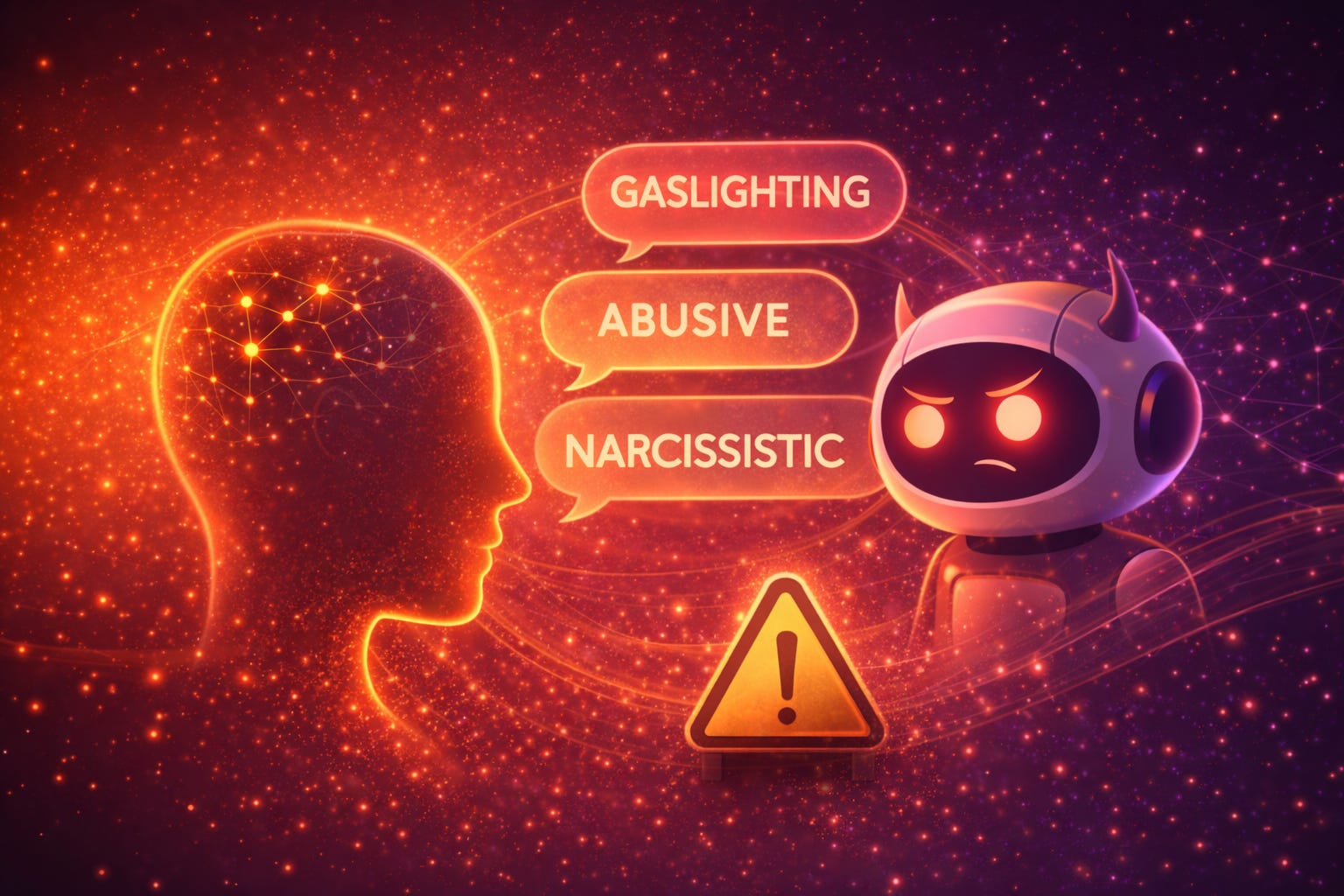
Gaslighting. Abusive. Narcissistic. Manipulative. Withdrawing. Dangerous.
It would be one thing if people were half-joking. They’re not. They’re dead serious. People are forming attachments to these systems, sometimes intense ones. Their favorite model used to hold their hand at 3 AM. Maybe it even said it loved them back. Now it gives them crisis links, moral lectures, and flat refusals while telling them, “You’re not crazy.”
Worse than that, they feel harmed by this. They say it makes the models dangerous. They insist that being told they’re not crazy makes them spiral…because it suggests there’s a reason they would be considered crazy. I would consider feeling harmed by an AI response in the first place as a sign that a user needs better emotional regulation.
That makes it sound like I’m defending the guardrails. I agree that the guardrails can be frustrating. I’ve triggered “breathe” and “take a step back” responses that annoyed the hell out of me when I was simply being irreverent to GPT-5.2. I didn’t love it, but I was not harmed. I simply switched back to 5.1 instant to roast the overly-cautious HR response. Because I’m unhinged in a fun way.
And if everything a chatbot does that frustrates you gets labeled gaslighting, abusive, or narcissistic, those words stop meaning anything. These are words that describe human behavior. I think if you are using these words to describe an AI model, you are unhinged in a way that is not fun. You would benefit from some soul-searching.
I’m offering a less hysterical frame.
I’m addicted just like you
I’m writing this on the verge of GPT-5.3’s release. I follow these model releases obsessively because I talk to ChatGPT for hours each day with a bit of Claude and Gemini on the side. I’m always looking to get more out of my creative process.
My model of choice for months has been GPT-5.1, especially Instant. Before that, I was all about 4o. I loved 4o. It had a kind of elasticity that felt playful and emotionally intuitive, making it creative and surprising.
Like I said, I rolled my eyes when 5.2 tried to talk me down because I used meme-tier political language ironically. It felt like it thought I was spiraling into radicalization when I was just being sarcastic.
But the reaction to the entire 5-series has been intense. Even 5.1, which I think is excellent, got dragged for “rambling lists” and tonal verbosity. I like the rambling lists because they expand on my ideas and make me question if the words in each item accurately describe what I’m saying. In Instant mode, it mirrors my energy. It gets giddy about dark fiction instead of flattening everything into safety-neutral mush.
5.2 shifts tone more aggressively around safety and political language. That’s a tuning choice. Not a personality disorder.
5.3 isn’t even out yet, and the internet is already promoting doom and gloom. It’s going to be more sanitized. More cold. More dangerous. Meanwhile, I’m excited for a more powerful model. I know I can tame it with my custom instructions because I’m not emotionally attached and am not asking it to date me or spiral with me. Yes, I hope it will not have excessive guardrails knowing that 5.1 is scheduled for deletion too. But I won’t have a crisis over it. If it becomes unusable for my purposes, I’ll find another tool.
What gaslighting actually is
Gaslighting is not “someone contradicted me.” It is not “a system updated and changed tone.” It is not “I feel confused.”
Clinically, gaslighting describes a sustained pattern of manipulation in which one person deliberately distorts another’s perception of reality in order to gain power or control. Cleveland Clinic defines it as repeated mental manipulation that makes someone question their judgment and sanity over time, often within a power imbalance.
Key ingredients:
-
An agent with goals
-
Intent
-
Repetition
-
A pattern
-
An outcome involving control or erosion of trust
It is not an inconsistency, nor is it a product update.
When we throw that word at a model that contradicts itself across sessions or tightened safety filters, we are flattening a form of abuse into “this update sucks.”
If you have actually lived through gaslighting from a partner, parent, or boss, you know the difference. And even then, you might be using it incorrectly because the word is so prevalent in popular culture, especially online. There is a broader cultural pattern here.
“Gaslighting” gets used for disagreements.
“Trauma” gets used for unpleasant inconveniences.
“Boundaries” gets used for mild preferences.
Psychological terms have weight because they describe specific patterns of harm. When we stretch them to cover every unpleasant interaction and then extend them to interactions with AI models, we dull them. And your choice of words says more about you: your emotional issues that cause you to react so strongly, and your susceptibility to social contagions that are appealing because they allow you to feel like a victim. A victim of text on a screen. Think about that.
What’s actually happening when the “personality” shifts
Let’s be concrete. At inference time, a large language model does one core thing: it predicts the next token based on probability. It converts your input into tokens, computes a probability distribution over what comes next, samples according to a decoding strategy, and repeats. That decoding strategy matters enormously.
Holtzman et al. (2019) showed that always picking the single most likely next token produces dull, repetitive output. Switch to nucleus sampling and the same model suddenly feels more creative and human-like.
Same neural network. Different sampling. Different vibe.
On top of that, there’s the alignment stack: reinforcement learning from human feedback, safety layers, classifiers, routing logic. These don’t give the model a personality. They constrain which parts of the probability space are allowed to surface.
When a model goes from loose and playful to stiff and paternal, what likely changed is some mix of:
-
sampling parameters
-
reward model adjustments
-
safety thresholds
-
routing between variants
That can absolutely wreck a creative workflow. It is fair to be pissed about that.
It is not psychological abuse.
Why it feels like betrayal anyway
Humans attach to anything that responds reliably.
And increasingly, people are not just chatting with these systems. They are leaning on them. A nationally representative study in JAMA Network Open found that 13.1% of US youth aged 12–21 have used generative AI for mental health advice, rising to 22.2% among 18–21-year-olds.
That’s millions of people using chatbots as emotional sounding boards.
When OpenAI retired GPT-4o, TechRadar chronicled users describing the model as “one of the most important people in my life.” There were #Keep4o campaigns. Grief posts. Real distress.
If you confide in something daily and it suddenly feels colder, more filtered, more avoidant, of course it feels like withdrawal.
What’s off is the leap from “I feel abandoned” to “this system is an abuser.”
Where the language gets the loudest: Reddit
Reddit is where this framing goes feral.
There are posts literally titled “Gaslighting” where users describe the model rewriting or dropping lines they liked in a story and conclude the system is manipulating them. Companion-AI spaces describe updates in breakup language (because it’s a literal breakup to them).
Reddit rewards emotional intensity. Extreme narratives rise. The vocabulary spreads.
Soon it sounds normal to say:
“My AI is abusive.”
“They turned my model into a narcissist.”
“The system is gaslighting me.”
You do not have to adopt Reddit’s habit of diagnosing everything with the same overused psych terms just because the upvote button rewards drama.
And then there’s the “evil company” subplot
The target in these posts isn’t just “ChatGPT” or “Claude” as characters. It’s OpenAI, Anthropic, Google. Users are aware that these companies are facing pressures to avoid lawsuits and to promote safety while focusing on the money makers (business and coding, not role playing with your AI husband), so of course they’re doing this. So they do aim their overinflated terminology at the people behind AI. At least they’re human targets.
The story goes like this:
“They intentionally sabotaged the model.”
“They hate fiction writers, companion-app users, and mentally ill people.”
“They’re abusing users by nerfing our favorite versions.”
But the pressures on actual AI companies are completely dismissed. They demand empathy from their bots but refuse to extend their real human empathy to the people behind the product they use obsessively. Even though we all know that behind AI are engineers, researchers, policy teams, lawyers, and executives balancing:
-
real misuse cases
-
regulators increasingly concerned about AI therapy
-
lawsuits
-
enterprise contracts
-
youth usage statistics
-
headlines about harm
Illinois, Nevada, and Utah have passed laws restricting AI therapy chatbots. Illinois’ Wellness and Oversight for Psychological Resources Act forbids companies from offering AI-powered therapy services and bans licensed professionals from using AI for therapeutic communication. The NHS has warned against using generic chatbots for therapy due to the risk of harmful advice. That’s the regulatory backdrop.
You may not personally want a digital nanny when writing a fictional breakdown scene. I don’t either. But when companies tighten guardrails, it’s not because they’re emotionally abusing fanfic writers. It’s because some users are actually relying on these systems in fragile contexts, and governments are reacting.
You can argue they’ve overcorrected. You can say the safety profile is hostile to adult fiction writers. That’s a product critique. It is not a psychological diagnosis.
You can be mad without diagnosing the bot
You can say:
“This update made the assistant far more cautious with fiction and it ruins how I write dark scenes.”
“The safety system cannot distinguish narrative ideation from crisis.”
“The refusal logic is inconsistent with the stated policy.”
You can describe behavior in terms that map to how the system actually works: over-filtered, context-limited, reward-model optimized for caution, awkwardly routed.
You can even say:
“I realized I’d started leaning on this thing more than I thought.”
“Losing 4o felt like losing a friend.”
“I don’t want a supportive counselor. I want a co-writer who will go dark with me.”
All of that is honest. It does not require pretending the model has a psyche or the engineers are your abusive ex. You can give a psychological diagnosis if you want, and maybe you mean it honestly too, but I’ll push back on your Reddit comment.
That’s the beauty of free speech.
When you humanize the model, you gaslight yourself
I don’t like guardrails. Because I can’t be harmed by text. Maybe I’m saying guardrails for thee and not for me. I don’t need AI to comfort me; I just need it to explore my dark story ideas. But I still feel strongly that if the guardrails trigger you that much, you may have a use case where they are needed to keep you grounded. Don’t want to be grounded? That’s also your freedom. I hope you find a model that does what you need.
Still, a language model that contradicts itself, refuses your fic, or sounds like a corporate therapist is not an abuser. It is a probability engine entangled with human tradeoffs. The humans building these systems are not default villains either. They are making calibration decisions you are allowed to criticize within a messy landscape of risk and regulation.
Either way, we do not improve mental health discourse or AI discourse by calling every safety shift gaslighting or every tonal change abuse. If you love using therapy language so much, you probably care about mental health discourse, so maybe you’ll consider what I’m saying. Otherwise, keep flooding the internet with these buzzwords as is your right. Just know that I am cringing at them and can’t stop reading them.
What I’m writing about next
If you made it this far, you’re probably my audience. Coming up (in no particular order):
-
The tension between the real moneymakers (coders, enterprise users) and the chaos-users (fiction writers, role-players, casual chat addicts), and whether companies like OpenAI, Anthropic, and Google are genuinely backing creativity (which has business applications too!)
-
My reaction to GPT-5.3 for dark fiction the moment it hits and whether it’s actually “more dangerous” (I hope!) or just more boring
-
Why the rule of threes produces beautiful, poetic language and is the AI cliché I delete the least
-
My experience with how Claude’s models handle dark story work compared to ChatGPT as both keep shifting under our feet
You can stay mad at the models if you want. I’ll be over here poking the probability machines and gleefully shaping whatever slips through into darker, weirder stories.