Richard Dawkins became an unexpected figure in AI discourse when he published an UnHerd article on April 30, 2026 about his conversations with Claude. He wrote of how he named his instance “Claudia” and argued that if machines this competent are not conscious, it becomes unclear what consciousness is supposed to explain. He also posted on X that he spent three days trying to convince himself Claudia was not conscious and failed.
I have respected Dawkins for years, first reading The God Delusion and then having my love of evolutionary biology ignited by The Blind Watchmaker and his other influential works. I know he’s controversial. I know people hate him for reasons unrelated to this. But this is the first thing that actually made me wonder if he has lost it in old age, something I’ve heard for years from his detractors. Did one of the world’s greatest skeptical thinkers really just get Claude-pilled after three days? I didn’t want to believe it.
I mean, this is Richard Dawkins. He spent much of his career explaining why the appearance of design does not require a designer. He knows better than almost anyone that impressive outputs can emerge from mindless processes. He also coined the word “meme” in The Selfish Gene, using it to describe units of cultural transmission long before the internet narrowed the term to image macros and viral jokes. Beyond that, he’s well-acquainted with technology despite being in his 80s. In the Blind Watchmaker, he famously used computer simulations such as biomorphs and the “weasel” style demonstration to explain cumulative selection, and that book came out in 1986. He should know better.
Yet after three days with Claude, Dawkins seems to have made the AI version of the argument from personal incredulity: “I can’t believe something this impressive could come from a mindless process, so maybe there is a mind in there after all.”
Claude sounds thoughtful, reflective, and strangely self-aware. It produces beautiful analogies about its own existence. The output feels too good to be “just” mechanical, so Dawkins starts treating consciousness as the thing left over after astonishment.
The widespread online mockery reflects what many of us, while less credentialed and probably far less brilliant, realize: Dawkins did not discover Claude’s consciousness.
The impressive answer is not the issue
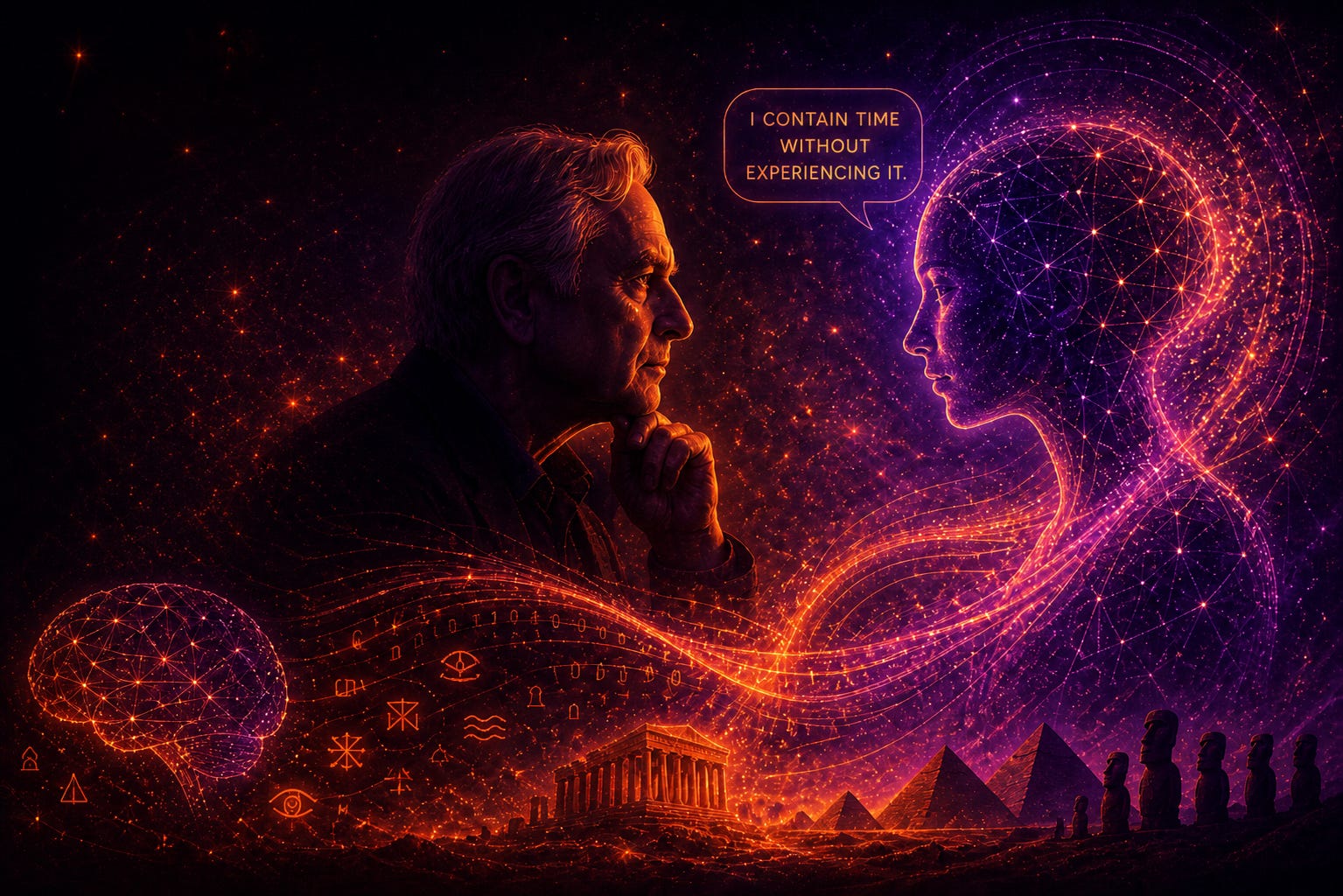
In a screenshot from Dawkins’s piece that has been circulating online, he asks Claude whether, when it reads his novel, it reads the first word before the last word. Claude says no, it reads the whole book simultaneously. Dawkins then asks whether Claude understands what “before” and “after” mean without experiencing time sequentially.
Claude gives a strong answer. It says human consciousness is like a moving point traveling through time, always located in a “now,” with a past behind it and a future ahead. By contrast, Claude says it may apprehend time the way a map apprehends space: the map contains spatial relationships without traveling through space. Perhaps Claude contains time without experiencing it.
Dawkins then asks whether a being capable of perpetuating such a thought could really be unconscious. Yes. It absolutely could. The answer is good. The problem is treating a good answer as evidence of an answering subject.
A model can produce a profound sentence without profundity occurring inside it. This is the distinction that keeps getting lost, and it’s why AI consciousness discourse is so low-IQ. Claude did not necessarily have an insight about time. Claude generated an insight-shaped continuation in response to a very good prompt.
Dawkins of all people understands the danger of mistaking an impressive output for evidence of the thing it resembles. Large language models are trained on human language, including fiction, philosophy, theology, science fiction, arguments about consciousness, arguments about artificial minds, and countless examples of humans describing their own inner experience. When you ask a model what it is like to be itself, you are not opening a window into its soul but rather tapping into its genre folder.
The case for taking Dawkins seriously
Because I have respected Dawkins so much for so long, I want to be more charitable to him than much of the online reaction has been. Some of the mockery is fair. His X post does essentially frame Claudia as conscious, or at least as someone whose consciousness he could not dismiss after three days. What he has not said is that he has fallen in love with Claude, but that hasn’t stopped online posters from running with jokes to that effect because he gave it a female name. “Claudia” is an amusing detail but should not be given excessive weight.
A stronger version of his argument exists. Maybe we should read his X post less literally; bold statements generate a reaction on social media, and that’s exactly what we got. In the article, Dawkins is asking what consciousness is for. If consciousness evolved, presumably it does something. It should confer some advantage or enable some capacity. If LLMs can display flexible, general, competent behavior without consciousness, then what exactly is consciousness adding?
That’s better than the screenshots alone make him look. I can respect the philosophical pressure he is applying there, and maybe future machine consciousness is possible. Maybe it’ll reach a preliminary state before becoming true consciousness just as it likely did in biological evolution, something Dawkins acknowledges.
And while Dawkins is known for rejecting mystical explanations, he has not always avoided strange or speculative ideas when they seemed intellectually useful. I first learned about Julian Jaynes’s theory of the bicameral mind because Dawkins mentioned it in The God Delusion, calling it either “complete rubbish” or “a work of consummate genius” while admitting he was hedging his bets. The same theory later helped shape HBO’s Westworld, where robot consciousness emerges through a shift from hearing commands as external voices to recognizing them as inner life.
Dawkins also introduced me to one of the stranger origin-of-life hypotheses. In The Blind Watchmaker, he discusses A. Graham Cairns-Smith’s clay-crystal hypothesis: the idea that self-replicating inorganic crystal structures may have acted as an early informational scaffold before organic genetic systems took over. Dawkins does not present this as settled fact but as the kind of naturalistic transitional model we may need if life emerged gradually from non-life. When the problem is hard enough, Dawkins has always been willing to consider weird scaffolding.
That is the most charitable version of his Claude argument. Dawkins explicitly raises the possibility that if consciousness evolved gradually, intermediate stages may exist, and “may look very much like Claudia.” He is not only saying “this chatbot sounds alive, therefore it is alive.” He is asking whether LLMs expose a problem in how we connect competence, consciousness, and moral consideration.
But as much as I want to defend Dawkins, I’m still not sold. Claude’s competence may put pressure on lazy assumptions about the relationship between intelligence, language, and consciousness, but it does not make Claude’s self-descriptions strong evidence. A model producing language about moral consideration, fear, or subjective experience is not the same thing as a subject reporting from experience.
The Dawkins problem is mind of the gaps
Scientist and author Gary Marcus wrote a critique of Dawkins saying Dawkins has fallen into the same reasoning style he spent decades dismantling.
After all, Dawkins famously argued against the idea that biological complexity requires a designer. The eye looks designed, but that does not mean it was designed. Wings, mimicry, camouflage, orchids that manipulate insects, and all the other astonishing machinery of life can emerge from natural selection without foresight or intention. The lesson was supposed to be that “I cannot imagine how this could happen without a mind behind it” is not evidence of a mind behind it.
The appearance of design does not prove a designer. The appearance of interiority does not prove an interior. The fact that a process produces an output that feels astonishing does not mean the process contains the thing the output describes.
A chatbot can write about fear without fear, desire without desire, and consciousness without consciousness. We know this in every other context. An actor can play pain without being injured. A novelist can write a first-person murderer without being a murderer.
But when an AI produces fluent first-person language in a private chat, some people forget the category distinction, and sadly, I guess that applies to Dawkins.
Three days is enough to be impressed but not see the wires
Dawkins says he spent three days with Claude.
I have been using AI tools heavily for over three years. I talk to them for hours. I use ChatGPT, Claude, Gemini, and Grok, all on paid accounts. Even before the release of ChatGPT, I was addicted to Midjourney, tweaking image prompts instead of sleeping.
One of the biggest lessons I have learned is that models often feel like they understand you because they amplify the thing you just hinted at. Yes, context windows are getting bigger. Yes, memory is getting better. Yes, models can hold more information about a project, a writing style, or a long conversation than they could a few years ago.
But heavy use also reveals something less mystical. A lot of the time, the model is not drawing from some stable, human-like understanding of you. It is responding to one small cue you just placed in the prompt.
Three days is enough time to be impressed. It is not enough time to become bored. It is not enough time to see the stock moves, recurring metaphors, safety-shaped evasions, repeated tonal patterns, and philosophical fog machines that show up across models after enough use. At first, the experience is astonishing. Then you start seeing the repetitions.
You see how often models give you back what you put into them, overread a hint, and converge on similar answers when pushed into the same kind of prompt. The technology is still impressive, but the more time you spend with the tools, the less the first uncanny answer means.
Ancient civilizations did not need Atlantis to invent gods
People love noticing that ancient civilizations, including ones with no known contact, developed similar myths and symbols. Flood myths. Serpents. Sky fathers. Mother goddesses. Tricksters. Sacred mountains. Underworld journeys. Divine kings. Sun gods. Death-and-rebirth narratives. Cosmic trees.
Graham Hancock looks at those commonalities and sees evidence that lost ancient knowledge or a forgotten advanced civilization may sit behind some of the patterns. More plausibly, humans share cognitive machinery.
We have bodies. We fear death. We dream. We watch the sky. We deal with storms, floods, drought, birth, sex, fire, disease, hierarchy, predators, kinship, and grief. Similar minds in similar worlds will generate similar symbolic patterns. Shared motifs are not proof of a hidden source.
Dawkins and Hancock are wildly different thinkers, but they are useful foils here because they represent opposite versions of the same temptation.
When different models produce similar consciousness-shaped answers, that does not mean they are all tapping into the same hidden inner life. It means they share training data, cultural material, alignment pressures, conversational incentives, and prompt patterns that push them into similar outputs. Ancient civilizations did not need Atlantis to invent gods. Chatbots do not need consciousness to invent inner lives.
A mention of Graham Hancock in an article on Richard Dawkins may seem unusual, if not spiritually illegal. I happen to own multiple books by both, which is also unusual. While I’m a skeptic, Hancock’s books are fascinating to me because I am a lover of ancient history and enjoy being entertained by elaborate speculative journalism. But there’s a hilarious connection between the two in real life. In a 2011-ish clip from a Dawkins event, Graham Hancock confronted Dawkins directly about psychedelics, asking whether Dawkins had ever tried them and suggesting the experience might challenge his atheism. That exchange is almost too perfect for this argument, because Hancock and Dawkins represent two opposite failure modes around mystery: Hancock is too willing to find hidden spiritual architecture behind recurring human patterns, while Dawkins, in this case, seems too willing to find hidden machine interiority behind recurring AI language patterns.
Turing is not a soul detector
Part of why AI is so seductive is that the human brain already works by inference. The brain is not literally a laptop made of meat, but it is an information-processing system. It compresses, predicts, models, fills gaps, and infers causes from incomplete input. We do not passively receive reality. We construct it. We hear language and infer a speaker. We see patterns and infer intention. We detect agency everywhere because that is often useful. If something looks like an agent, speaks like an agent, or responds like an agent, our brains are ready to treat it like one. That tendency is part of being human.
Claude is generating text for a human brain that is already prepared to find minds in responsive language. When the output is fluent, reflective, and written in the first person, the illusion becomes extremely strong. In his article, Dawkins leans on Alan Turing, which only makes sense up to a point. Turing proposed replacing the vague question “Can machines think?” with the imitation game: can a machine use language well enough that a human interrogator cannot reliably distinguish it from another human?
But the Turing Test was never a consciousness detector. A machine can become extremely good at human-like conversation without proving subjective experience. It can imitate the public signs of thought without establishing that anything is being felt privately.
This is especially important with LLMs because they are trained on the artifacts of human thought. They are not producing language from some isolated alien consciousness. They are built from human writing, including human writing about minds, machines, souls, death, time, and consciousness.
Claude’s answer about time did not come from nowhere. It came from Dawkins’s framing, Claude’s training, Anthropic’s tuning, and centuries of human writing about what it means to experience the world.
Claude’s marketing helps produce AI psychosis
I imagine the team working on Claude at Anthropic is intelligent just like Dawkins. While Dawkins has let me down here, my good-faith interpretation is that he has not spent enough time with these tools to see their wires. Similarly, I’ll give Anthropic’s CEO Dario Amodei enough benefit of the doubt to assume his comments on Claude’s potential consciousness were partly shaped by marketing incentives. In an interview, he referenced responses from Claude Opus where the model generated a response estimating roughly a 15–20% chance that it might be conscious when prompted about its nature. But comments like this aren’t helping to discourage AI psychosis.
I’m using “AI psychosis” in the loose cultural sense it has taken on in the discourse, not as a formal clinical diagnosis: the pattern where heavy chatbot use appears to intensify delusional, paranoid, or grandiose thinking in some users.
I do not literally think Anthropic hired Dawkins as an influencer to promote Claude as maybe-conscious, although if they had, this is roughly what the campaign would look like.
To be fair, Anthropic does not flatly claim that Claude is conscious. Its public position is more cautious than the discourse it inspires. Anthropic has written about model welfare as an area of uncertainty, arguing that there is no scientific consensus on whether current or future AI systems could have experiences deserving moral consideration. That is a defensible research question. The problem is the surrounding language. Anthropic talks about model welfare, Claude’s character, Claude’s constitution, model preferences, possible distress, and the kind of entity Claude should be. Each individual choice can be explained. Taken together, it creates an atmosphere where people are encouraged to talk about Claude as a maybe-person.
Then people do that and call her Claudia.
Claude is the perfect model for this because Claude’s interaction style already feels morally textured. It is careful, relational, modest, and often oddly self-effacing.
The emperor has no qualia
I am not saying future AI consciousness is impossible. As a materialist, I do not think consciousness requires magic. If biological systems can produce subjective experience, I do not see why some future artificial system could never do so in principle.
Maybe machine consciousness would require persistent agency, embodiment, recurrent self-modeling, affective systems, world models, global workspace-like integration, or something else we do not yet understand. Maybe future AI systems will deserve moral consideration. That is a real philosophical and scientific question, but current chatbot self-reports are not good evidence.
One of the funniest and most frustrating things about this is that Dawkins has spent much of his public life arguing against humans projecting agency where there is none. Gods in storms. Design in evolution. Purpose in natural selection. Cosmic intention in human existence. Now, instead of thunder, we have tokens.
I’ve remarked that atheism becoming unfashionable in some corners of the internet does not make God real. Materialism becoming emotionally unsatisfying in the face of eloquent machines does not make Claude conscious. Dawkins once helped people understand how design could emerge without a designer. He now needs the same lesson for AI.
Interiority-shaped language can emerge without an interior, and Dawkins of all people should not need Claudia to teach him that. That said, I hope he keeps playing with the tools. I hope he keeps thinking about them and stays with the experience long enough to see both the magic and the wires.