Hank Green has spent decades making science content online. Along with his brother John Green, he launched Vlogbrothers and helped create projects including Crash Course and VidCon, and he has remained one of the internet’s most prominent science communicators. His core audience also leans left-of-center, and there’s significant anti-AI sentiment among his followers. So when they discovered that he had been using ChatGPT as part of his research process, the backlash was intense.
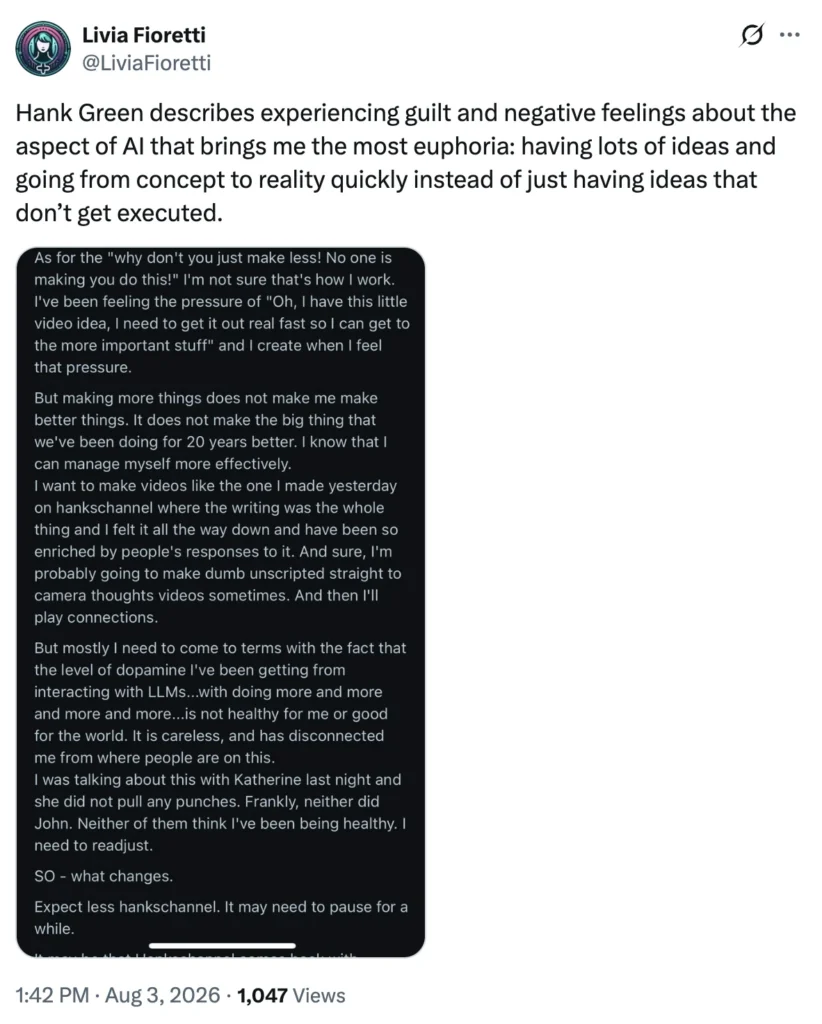
Green ultimately apologized and said he had been relying too heavily on AI as a research aid. In a Reddit post, he explained that ChatGPT was useful for rapidly surfacing papers he did not know existed, but he felt that this convenience had interfered with his ability to find his own ways into and around a subject. He subsequently announced that he was reducing his output and might pause his personal YouTube channel for a while.
I don’t follow Green’s output though I’ve been aware of him for many years, so I entered this discourse mostly because it became impossible to avoid on X. I also found the outrage over using AI for research ridiculous, especially since Green was still checking sources rather than simply asking ChatGPT a question and putting whatever it hallucinated into a science video. But another part of his explanation interested me more.
Hank Green expresses guilt for enjoying the best thing about AI
Green wrote about the pressure of constantly having ideas and wanting to get them out quickly so he could move on to other things. Then he described needing to “come to terms” with the “level of dopamine” he had been getting from interacting with LLMs and from doing “more and more and more and more,” which he had concluded was unhealthy for him.
That is almost exactly the part of using AI that brings me the most euphoria.
I have ADHD, too many ideas, and a long history of leaving those ideas in various states of incompletion. AI dramatically compresses the distance between thinking “I should make this” and having something real enough to refine. I have used it to develop websites, design graphics, research (and write!) articles, improve SEO, and develop an elaborate science fiction world. I even created my own custom app for building that world with both local and commercial LLMs plugged into it. And that’s just my personal use: my career also involves web design, development, and SEO, so obviously I use AI heavily at work too and am pushing my team to explore every capability of the available tools, fueled by what I know is possible from my personal experiments.
I previously described this feedback loop in my posts AI-Induced Hypomania and Ritual Reuptake: Prompt, Reward, Repeat, Escalate. The latter is my attempt to describe why interacting with an AI model can become so compelling during creative and technical work: each response creates another opportunity to move something forward. Sometimes the response is good. Sometimes it is surprising. Sometimes it is wrong in a useful enough way that correcting it becomes the next prompt.
So while Green was describing a process he had begun to feel guilty about, I was thinking: wait, this is the good part. I had to post.
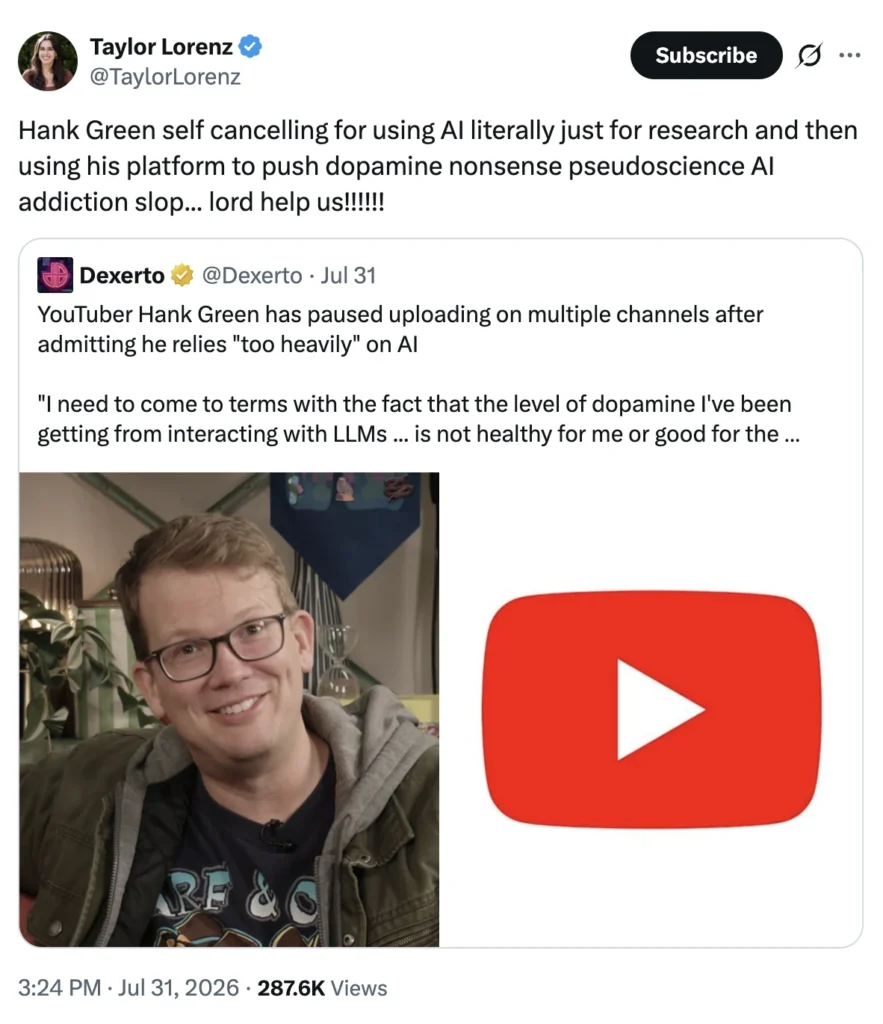
I was already getting suspicious of the dopamine explanation. Then Taylor Lorenz read my mind.
The discussion sent me down a different rabbit hole than the one apparently intended. I have no reason to question Green’s conclusion that he wanted to change his own workflow. What bothered me was how natural it has become to explain any intense engagement with technology by invoking dopamine, as though mentioning the neurotransmitter does the important scientific work. We’re all used to seeing these takes:
- AI is addictive because it gives you dopamine.
- Social media is addictive because likes give you dopamine hits.
- TikTok hijacks your dopamine.
- Notifications train your brain to crave more dopamine.
- You need to stop scrolling so your dopamine receptors can recover.
At a certain point, I started wondering how much of this was neuroscience and how much was the latest way for puritans to say that something feels too enjoyable.
I was naturally chatting with ChatGPT about this while deciding whether there was enough substance for an article when Taylor Lorenz suddenly posted the sentence I wanted.
Lorenz, responding to the Hank Green controversy, described him as “self cancelling” for using AI for research and criticized him for pushing “dopamine nonsense pseudoscience AI addiction slop.”
I was stunned.
Taylor Lorenz is a common character in online discourse I follow and certainly not someone I expect to read and think, yes, exactly. She promotes controversial views like defending the admiration surrounding Luigi Mangione, who has pleaded not guilty to murdering UnitedHealthcare CEO Brian Thompson, and is widely mocked for taking 2020-era COVID precautions six years later (she masks in public to this day). Her politics obviously skew far to the left, and a significant portion of her audience is aggressively hostile toward AI.
Yet lately she has been out there on X fighting with her own audience over some of the same anti-AI arguments that have been making me insane. I can’t help that I suddenly really like her, and I cringe at writing a disclaimer about how I don’t have to agree with her on everything. Obviously I don’t, and that’s never been my criterion for respect anyway. Lorenz is now one of my heterodox heroes for breaking with her faction.
She mocked an elaborate Threads post connecting data centers to military surveillance, eminent domain, Christian nationalist Armageddon, water hoarding, and billionaire bunkers as “data center psychosis” (though she apologized to her audience for the stigmatizing language, which you won’t find me doing when I use AI psychosis as a meme). She pushed back on the claim that AI prevents people from discovering new information. In another post, she complained that people criticizing AI without actually engaging with technology were crowding out the thoughtful tech criticism we could genuinely use.
This isn’t entirely new for her. Lorenz has been arguing that the moral panic around social media and mental health is being used to justify increasingly invasive regulation. She has specifically criticized age-verification laws that require users to prove their identity or age, arguing that efforts supposedly meant to protect children can normalize biometric surveillance, restrict anonymous speech, and expand censorship. She’s making exactly the connection that interests me: once a technology gets labeled addictive and psychologically dangerous, that framing becomes part of the case for controlling how everyone is allowed to use it.
Apparently we arrived at the same argument from very different political starting points. More importantly, “dopamine nonsense pseudoscience” has a strong scientific case behind it.
What dopamine actually does
The first problem with the popular version of dopamine discourse is that dopamine is still routinely described as the brain’s pleasure chemical. That description is useful in roughly the same way that describing your entire computer as the “internet box” is useful. There is something recognizable underneath it, but you are going to get into trouble very quickly if you try to reason from there.
One of the most influential bodies of work on dopamine comes from psychologists Kent Berridge and Terry Robinson, who distinguish between the processes of liking and wanting. These sound almost interchangeable in ordinary speech, but they can be separated both psychologically and neurologically.
“Liking” refers to the hedonic impact of a reward: how pleasurable it actually feels.
“Wanting,” in this framework, refers to incentive salience: the motivational pull that makes a reward or its associated cues attractive enough to pursue.
Mesolimbic dopamine systems play an important role in this motivational “wanting.” The actual hedonic experience of “liking” depends on other systems and does not simply rise and fall with dopamine. That distinction has become particularly important in addiction research because people can intensely want something even when they no longer enjoy it proportionally.
Dopamine is also deeply involved in learning.
A major line of research associated with neuroscientist Wolfram Schultz examines dopamine signaling through reward prediction errors: differences between the reward an organism expected and what it actually received. When a reward is better or worse than predicted, that difference provides a learning signal that helps update future expectations and behavior.
When I send ChatGPT a prompt, I do not know exactly what I will get back. Most responses fall somewhere between predictable and useful. Some are disappointing. Occasionally a response makes a connection I had not considered and gives me an entire new direction to explore.
Of course that kind of feedback is reinforcing. Learning from rewards is one of the things dopamine systems are there to help us do. The scientific leap happens when reinforcing gets quietly converted into pathological.
“AI gives you dopamine” explains almost nothing
Suppose I spend an hour developing an idea with an LLM. I ask a question, get an interesting response, revise my premise, ask another question, and eventually have a much better understanding of whatever I was thinking about. Did reward circuitry participate in that process? Almost certainly. So what?
The same broad motivational systems participate when someone solves a difficult problem, wins a game, discovers a useful paper, gets praise from another person, makes progress on a project, eats food, exercises, or learns something interesting.
Saying an activity “gives you dopamine” does not tell us whether the activity is worthwhile or harmful. It barely tells us anything until we specify what dopamine is doing, where, under what conditions, and how that mechanism relates to the behavior we care about.
AI does have several properties that plausibly make repeated interaction unusually compelling. Feedback is fast. Responses contain novelty. The quality varies. There is frequently another obvious thing to ask. A mediocre answer may still give you something worth correcting, which means even a partial failure can reinforce another round of engagement.
In behavioral terms, that is interesting, and it is also not remotely enough to diagnose addiction. If your argument is that I received something useful, experienced the result as rewarding, and wanted to try again, congratulations. You have discovered motivation. This is the part of the AI feedback loop I described with “ritual reuptake.” The point was never that the loop exists outside reward mechanisms. The reward is precisely why it works. AI makes the next step visible before the motivation attached to the previous one has disappeared.
For someone prone to generating ideas faster than she executes them, that can feel almost absurdly powerful. Calling that effect “dopaminergic” doesn’t transform it into a disorder.
Social media taught us how to talk about dopamine badly
AI inherited this language from more than a decade of discourse around smartphones and social media.
The formula is already familiar:
- A notification gives you a dopamine hit.
- A like gives you a dopamine hit.
- Infinite scroll exploits dopamine.
- TikTok is a dopamine machine.
- Your phone has hijacked your brain.
There are serious research questions underneath those claims. Social rewards can reinforce behavior. Platform design can encourage repeated engagement. Habits form around environmental cues. Some people genuinely feel that their use becomes difficult to control. But popular explanations tend to collapse all of those processes into suggesting dopamine functions almost like an addictive substance being administered by an app.
Researchers Ian Anderson and Wendy Wood found something even more interesting when they studied 1,204 Instagram and TikTok users. Far more people described themselves as addicted than met the study’s threshold for addiction-like symptoms. The authors argue that much of our frequent social media use is better understood as habit, and they found that thinking of yourself as “addicted” was associated with feeling less control over your behavior and greater self-blame.
This is where the language starts doing cultural work that goes far beyond neuroscience. Dopamine has become a way to medicalize the suspicion that modern activities are too immediately rewarding.
Instead of saying someone likes scrolling too much, we can say their dopamine system has been hijacked.
Instead of saying an app is very good at giving people content they want to see, we can describe it as exploiting neurological vulnerabilities.
Instead of establishing that a particular pattern of use is actually harmful, we can point to the existence of reward and treat the harm as already proven.
The language sounds scientific enough that it’s easy to accept and repeat without questioning what the neuroscience actually establishes.
Dopamine detox may be the purest example
The popularity of “dopamine detoxing” illustrates how far this can drift from the underlying science. The concept was popularized by psychiatrist Cameron Sepah as a behavioral method for reducing compulsive habits, drawing heavily from cognitive behavioral therapy. Despite the name, Sepah explicitly said that the goal was not literally to reduce dopamine. Naturally, the internet took it literally.
The concept mutated into the idea that people were overstimulating their brains with phones, games, music, food, sex, and other rewards and needed periods of deprivation so their dopamine systems could reset. Harvard Health described this interpretation as a misunderstanding of the science. Avoiding stimulating activities does not simply drain or replenish a store of dopamine, and a “dopamine fast” does not work by lowering dopamine levels.
Cecilia Flores, a McGill psychiatry professor who studies the dopamine system, made the same point more directly: even sitting alone in a room without obvious stimulation would not stop dopamine release, because dopamine participates in ordinary functioning and survival.
Taking a break from compulsive behaviors can obviously change your habits. Turning off notifications may help you focus, and deleting an app you keep opening automatically may reduce how often you use it. You’re still not detoxifying yourself from your own neurotransmitters. The irony is that the behavioral advice can be perfectly sensible while the neurological explanation attached to it is garbage.
Addiction requires more than wanting to do something again
The more useful question is what addiction researchers look for when a behavior becomes problematic. The details vary across substances and behavioral disorders, and “social media addiction” or “AI addiction” are not established diagnoses sitting neatly beside substance use disorders in the DSM. But addiction frameworks generally care about more substantial things than frequent use or strong enjoyment:
- Impaired control
- Persistent behavior despite significant negative consequences
- Failed attempts to reduce use
- Interference with important obligations or activities
- A pattern becoming difficult to regulate even when the person wants to regulate it
That immediately makes raw usage numbers less impressive. Someone can spend eight hours interacting with an LLM because they are coding.
Or researching.
Or studying.
Or writing fiction.
Or roleplaying a depraved romance for eight hours.
I don’t particularly care which ones sound productive. Productivity is not the criterion for whether an adult should be allowed to enjoy their time.
But sure, there are real questions that involve how well you can control the non-productive uses and whether the consequences are meaningful if you can’t. There are also specific use patterns where we have plausible psychological mechanisms for harm that are far more informative than vague dopamine language. Compulsive reassurance seeking is an obvious example. Someone with anxiety or OCD can repeatedly seek certainty, experience brief relief, become uncertain again, and repeat the behavior. AI can make reassurance permanently available, which gives an existing pathological loop a very efficient interface.
That tells us something that “chatbots give dopamine hits” does not.
What research on problematic AI use actually says
AI is new enough that the empirical literature is still trying to establish what problematic use should mean, so naturally, there is a wide gap between the research and online rhetoric.
One of the largest early efforts came from OpenAI and MIT Media Lab researchers in 2025. Their work included an analysis of millions of real ChatGPT conversations, surveys of thousands of users, and a four-week randomized controlled trial involving 981 participants and more than 300,000 messages. The researchers examined loneliness, real-world social interaction, emotional dependence on AI, and what they called problematic use.
The findings were not remotely as simple as “more chatbot equals more addiction.”
Very high usage was associated with worse outcomes on several measures, including greater self-reported dependence and reduced real-world socialization. But outcomes varied according to conversation type, modality, initial emotional state, attachment tendencies, trust in the chatbot, and duration of use. Personal conversations were associated with higher loneliness under some conditions while also being associated with lower emotional dependence and problematic use at moderate levels. Non-personal conversations were associated with greater dependence among some heavy users.
That’s why you can’t treat “AI use” as one psychological behavior. A 2026 review of problematic generative-AI use makes that distinction explicit: current measurement tools are still being validated, and researchers say the boundaries between high engagement, problematic use, and addiction-like behavior remain unclear. Some of the emerging evidence also suggests that motivations matter; using AI to escape negative emotions or replace unmet social needs appears more closely related to dependence than using it instrumentally for tasks or productivity.
Research on AI companionship shows similarly complicated selection effects. A 2025 study of more than 1,100 AI-companion users found that people with smaller social networks were more likely to use chatbots for companionship, while more intensive companionship use and greater self-disclosure were associated with lower well-being, particularly among users with weaker human social support. That matters, but it also creates an obvious causal question: are chatbots producing the isolation, are socially isolated people using chatbots differently, or are both processes happening together?
More recent work has examined how emotional dependence can emerge even from AI interactions that do not begin as companionship. One 2026 paper reviewing emerging evidence argues that emotional support can arise incidentally during ordinary task-oriented AI use and potentially shift where users later seek support.
These are interesting findings that are far from proving a rapid feedback loop is unhealthy because it produces dopamine.
Even OpenAI’s later safety work defines concerning emotional reliance in terms of unhealthy dependence or attachment to ChatGPT, particularly when that attachment comes at the expense of real-world relationships or support. OpenAI’s research suggests these patterns are concentrated in a relatively small subset of users rather than being typical of ChatGPT use, but the company now treats emotional reliance as a distinct category in its standard safety evaluations.
Social media addiction is still scientifically contested too
Just as I think there’s a moral panic around AI’s dopamine-inducing qualities, I’ve always been frustrated by the conversation around social media. An algorithm gives you more of what you like. It’s inevitable technology. Yet people talk about apps recommending content and keeping you engaged as if the manipulation involved is profoundly immoral if not outright demonic. And yes, they keep you engaged to show ads, but only so you can use a product you like using for free, and yes, you’re the product, but you’ve accepted the tradeoff if you’re still scrolling. Also, I argue for building your sense of agency: don’t blame the app, the bot, the manipulative post, or the deepfake. Just as human input is crucial for directing AI, exercising our discernment is crucial in today’s digital age. You can use critical thinking, and you can turn off your phone. But I’m sympathetic if you don’t find it easy.
After all, there is plenty of research documenting problematic social media use and associations with poor mental health, sleep disruption, impaired functioning, and difficulty controlling behavior. There are researchers who believe a social media use disorder can and should be formally classified. But “social media addiction” itself remains contested, including basic questions about whether heavy engagement represents an addiction in the clinical sense, a habit problem, a coping behavior, a symptom of other vulnerabilities, or different phenomena being collapsed under one label.
A 2026 BMJ discussion on the evidence for social media addiction appeared against exactly this backdrop, after major litigation in the United States treated addictive product design as a central theory of harm. Scientific language does not remain inside journals. Once we start describing interfaces as addiction machines, the argument naturally expands into what governments should require companies to change.
Taylor Lorenz has been making precisely this connection, arguing that the moral panic around social media addiction is increasingly being used to justify age-verification systems and restrictions that create their own privacy and free-speech problems.
If you’re going to use addiction as part of the case for regulating technology, you should be sure that you have demonstrated addiction rather than extremely effective habit formation, high engagement, or behavior you simply dislike.
“Dopamine” is doing too much work
This is ultimately what bothers me about Hank Green’s explanation. Maybe he was making too much content. Maybe using AI made it too easy for him to chase every idea. Maybe he prefers his work when he spends longer researching and writing each piece. Those are concrete explanations that apply to him personally.
“The level of dopamine I’ve been getting” adds an air of neurological specificity. That phrasing reflects a broader cultural habit where dopamine is treated simultaneously as the mechanism, the diagnosis, and evidence that the mechanism is dangerous. An activity feels unusually compelling. Dopamine participates in compelling behavior. Therefore, the technology has caused a dopamine problem.
AI may eventually produce entirely new patterns of behavioral dependence that deserve their own terminology and interventions. The ability to generate personalized responses indefinitely, simulate relationships, provide reassurance on demand, and adapt to individual users creates psychological conditions that social media never had. That makes careful research more important, but we can avoid the puritanical moral panic and trash neuroscience.
Taylor Lorenz is right: AI needs higher quality critics
I am ending this article by coming back to Taylor Lorenz because I think her voice is needed in today’s AI discourse.
Lorenz is unusually well-positioned to push back on low-quality criticism of AI because she is not doing this with an audience that already loves AI. Much of her audience is deeply skeptical of it, and she remains sensitive to concerns about tech-company power, surveillance, labor, and other issues associated with the political left. Yet she is still willing to tell that audience when its technology criticism becomes hysterical or scientifically sloppy. She is genuinely in a position where she could change the minds of some of the left’s most fervent AI-haters. She’s already using multiple AI tools in her own workflow, so maybe one day she’ll be able to use AI-generated YouTube thumbnails and not lose subscribers en masse.
And if “dopamine nonsense pseudoscience AI addiction slop” becomes the phrase that finally gets people to ask what dopamine actually does before blaming it for whatever technology scares them next, I am happy to steal the framing.