We already have the term “AI psychosis,” which gets applied to everything from literal delusional spirals to even Richard Dawkins finding it difficult to convince himself “Claudia” is not conscious. Fine. The term is messy, but the phenomenon is real enough around the edges.
But I think there is another AI-induced mental state worth coining because it does not look like collapse and may not be negative at all. It looks like productivity. It looks like joy. It looks like opening a chat window with a vague idea and leaving three hours later with an essay outline, a branded visual concept, a working prototype, and the deranged conviction that your entire life has been waiting for this exact tool.
I’m calling this AI-induced hypomania.
I do not mean literal clinical hypomania in every case, and I’m not diagnosing everyone who stays up too late with ChatGPT and suddenly believes they can build a media empire, a startup, a novel series, and a new religion before dinner. I mean the joy and productivity one experiences when making a major breakthrough in a project because AI helped flesh out and execute a concept rapidly. It is an accelerated creative state where the distance between imagining something and making something collapses.
That sounds almost wholesome, though the actual experience feels less like “healthy productivity” and more like your dopamine system discovering industrial machinery.
Before AI, you had:
idea → overwhelm → draft attempt → research → skill gap → boredom → avoidance → maybe someday
With AI, it becomes:
idea → prompt → structured concept → outline → draft → image → website → launch plan → fully branded project with a tagline, color palette, and suspiciously competent roadmap before lunch
That is not normal creative pacing. The ape brain was not designed to watch an idea become semi-real in thirty seconds. The dopamine system is sitting there like, “Oh, we’re gods now? Sick.”
Historically, creative ambition and execution existed on different timescales. You could imagine a novel in an afternoon, but writing it might take years. You could envision a software product instantly, but building it required months of learning and labor. AI doesn’t eliminate those timelines entirely, but it compresses the earliest stages so dramatically that the brain experiences a kind of temporal distortion. The future arrives faster than expected.
The danger is that your own potential becomes too real, too fast, and it’s not really a danger unless you have other things you should be doing instead. In this article, I discuss this phenomenon alongside my own journey of ecstatic creation, which I previously teased in my post On Being Sane While Demanding Unhinged Models.
The first hit was image generation
For me, this did not start with ChatGPT. I signed up for ChatGPT days after its release on November 30, 2022, but mostly used it as a Google-replacement. I was still deep in my image generation spiral on Midjourney, which was my first experience using an AI tool for hours on end. As a writer, I did not trust an LLM to write better than I could. Sure, I had dreamed for years of building an AI bot to inspire poetry by giving me unexpected phrases in my own voice, but ChatGPT couldn’t even write a poem without rhyming at the time. And my email communications were already killer.
Midjourney was different because it did not ask me to trust a machine with prose. It asked me to imagine. Then it rewarded the imagining immediately. I could describe an aesthetic, a mood, a character, or a visual world that previously would have remained mostly private because I did not have the technical skill to render it myself.
That does not mean the output was exactly what I imagined. Often, it was not. But it was close enough to continue. That is the hook. AI does not need to produce the perfect version of your idea to change your relationship to the idea. It only needs to give you something tangible enough that your brain goes, wait, this is possible. The vague thing has edges now. It has enough reality that you can react to it, refine it, reject it, or chase it further, and I did for hours every night for weeks.
That feedback loop is intoxicating because it is not passive consumption. It is iterative control over possibility space. You are steering the slot machine with your own language, which is a completely insane thing to give a pattern-seeking primate with unresolved creative ambition.
Of course people get obsessed.
Why text generation took longer to click
For a while, I used ChatGPT and Gemini strictly for practical and work-related questions such as troubleshooting website code. It was useful. It was impressive. It was not yet magic.
Part of that was because I write. Image generation let me access a skill I did not have. But in spring and summer of 2025, I chatted with GPT-4o endlessly about my creative sci-fi ideas.
AI can participate in the messy pre-writing phase where most ideas usually die. Before AI, an idea could sit in my head for years because developing it required too many intermediate steps. You have to name things. Structure things. Test implications. Generate examples. Notice contradictions. Hold all of that in your head while also having a job, a life, and a brain that does not always feel like opening the correct filing cabinet.
AI changes that. It turns “I have a vague idea” into “here are six possible structures.” It turns “I don’t know what I mean yet” into “here are three versions of what you might mean.” It turns “I should really do something with this someday” into “here is a draft section, and now you are mad at it in a useful way.”
ADHD and AI converging to keep the loop alive
I suspect this effect is especially powerful for people with ADHD-like tendencies. Not because AI cures executive dysfunction, but because it removes many of the activation barriers that normally kill projects before they begin. ADHD is strongly associated with executive-function difficulties, including planning, organization, and sustaining effort, which helps explain why lowering the friction around starting can feel so dramatic.
The challenge shifts from starting to selecting. Instead of struggling to generate momentum, you suddenly have too much of it. That matters because ADHD is also often discussed through reward timing and delay aversion: if the payoff is too distant, the task can lose its grip before it starts. AI makes the payoff immediate enough to keep the loop alive.
This is also where the word “hypomania” becomes useful, even if imperfect. ADHD and hypomania are not the same thing, and hypomania is most commonly discussed in the context of bipolar II. But they do share some visible features: increased activity, distractibility, impulsivity, racing thoughts, talkativeness, and the sudden rearrangement of every plan in your life because one idea got too shiny. AI-induced hypomania can describe what happens when a tool temporarily gives an ADHD-inclined brain the velocity, reward feedback, and execution support of a very productive little mood episode.
Bad AI output is still creatively useful if it gives you something to push against. Sometimes the model gets it wrong, and you realize what you actually think. Sometimes it overstates your idea, so you pull it back. Sometimes it makes a connection you would not have made yet. Sometimes it produces a phrase that is not right but points toward something that is.
The breakthrough is not that AI replaces the human mind but that it riffs off its thoughts. That brings me to my own next breakthrough.
The breakthrough high: creative worldbuilding
It was the spring of 2025 when I unlocked the power of text generation for my creative process and started using AI for serious idea development. Developing my scifi novel series with 4o was like magic. Partly because there was a magic to the model itself and mainly because I was new to experiencing the magic of working with AI this way. I’ve since worked with GPT-5.5 and Claude’s newer Opus models, and these models are blatantly more powerful than 4o, but 4o will always hold a place in my heart. And every day, I find more magic in ChatGPT’s latest model despite my initial reaction that 5.5 was another creatively boring model.
This is where AI-induced hypomania becomes especially obvious. Creative projects often fail because the distance between the initial excitement and the actual execution is brutal. You start with vibes. Then you realize vibes are not a structure. Vibes are not an argument. Vibes are not a plan. Vibes are not a finished thing.
AI helps bridge that gap before the original spark dies. That does not mean it does the hard work for you. It means it keeps the spark oxygenated long enough for structure to form around it.
And once a project becomes real, the brain starts treating it differently. A vague idea can be abandoned with almost no guilt. A named project with documents, images, notes, drafts, and a growing internal logic starts making demands. It becomes a little creature on your desk. You fed it after midnight and now it has opinions. That is where the productive mania comes in. You are not just imagining anymore. You are building.
My own obsession with scifi wordbuilding has now continued for over a year with ChatGPT, Claude, Grok, and now my own local bot running OpenAI and (when I buy the API key) Anthropic models, which will be my final example
Accelerating the process of blogging about AI insights
The same thing happened with this Substack. I had opinions about AI, creativity, psychology, model behavior, and the bizarre emotional culture forming around these tools. As each new controversy inflected the discourse, I had plenty to say. But reading about AI is a hobby, and I don’t want to spend more than 1-2 hours on each post when I have a job. That’s where ChatGPT and Claude come in.
AI helped turn recurring thoughts into structures. Once I say what I think, it can hold up a mirror with enough distortion that I can recognize the parts worth sharpening. It helps me test titles, structure arguments, find missing sections, cut repetition (just kidding, I have to do that part for it), and notice when I’m making the same point three times (another one that’s usually a human edit, but it can double check I didn’t miss anything when I’m done)
This is one of the stranger effects of AI on writing: it can make your own ideas feel more external to you. Normally, a half-formed thought lives in your head as a fog. You know the shape of it emotionally, but you may not know the argument yet. Once AI reflects it back in text, even imperfectly, the thought becomes an object. You can inspect it. Attack it. Rewrite it. Decide whether it is actually interesting or just sounded good while you were pacing around your kitchen like an underfunded prophet.
AI does not eliminate the need for the creator. It makes the creator more responsible for curation. The machine can generate options forever. Congratulations, you now have infinite clay.
The technical breakthrough: Building a functional app in one day
The latest escalation, for me, was building a local AI writing app in one day on a local node server with just ChatGPT 5.5 (not Codex), terminal, and Sublime. I do have some relevant background. I work in marketing and web development, though my current role is mostly leadership and client communication. Nearly a decade ago, I built some custom WordPress themes and simple apps for fun. I was online early and made static HTML websites as a child, but I mostly dropped the interest as a teenager and in my early 20s before getting back into it all.
So I was not totally lost. But it is still insane what is possible with AI.
The important part is not that I built the world’s most impressive app. I did not. The important part is that I went from “I want a tool that does this” to “I have a crude version of the tool that does this” in a single day. And honestly? It’s better than crude. I did so much more than I expected I would on my old MacBook Air that couldn’t run Codex or Claude Code (and the web version of Claude Code had me going back to my simple ChatGPT thread). In the morning, I asked ChatGPT to make some mockups, then went out for hours, and that night, I built the whole thing. I had a desk arriving in two days, and I’d be able to set up one of my newer iMacs upon its arrival, but I could not wait. Now I have a real starting point.
That changes the emotional relationship to the idea. A thing that exists can be improved. This is the part of AI that still feels surreal. It does not merely help you think. It helps you instantiate until your concept is alive enough to demand revision.
The ecstasy I felt after building my app in a day inspired me to write this article instead of one about that process itself. This is the core mechanic: AI collapses manifestation latency, and it removes friction so your creative process can suddenly move at the speed of your excitement.
The model is not the drug. The loop is.
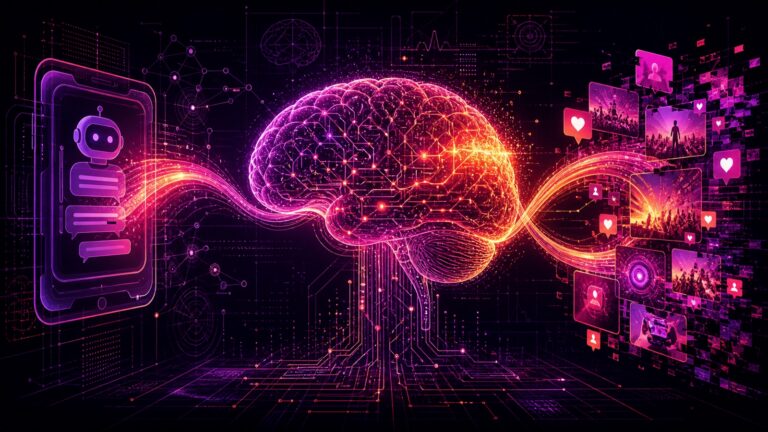
People often talk about AI addiction as if the chatbot itself is the addictive object. Sometimes it is, especially for people using models for emotional support or companionship. But for creative work, I think the addictive object is often the loop.
Prompt → output → reaction → refinement → better output → new idea → new prompt.
That loop can become self-reinforcing very quickly because each exchange gives you another little hit of progress. The model does not have to be perfect. In fact, imperfection can make the loop more addictive because it invites correction. You keep seeing what it almost got right. You keep wanting to adjust it. You keep thinking one more prompt will unlock the thing.
Behavioral psychologists have known for decades that variable reward schedules are among the most powerful reinforcement mechanisms. Slot machines work this way. Social media works this way. AI creative workflows often work this way too: most outputs are mediocre, but occasionally the model produces exactly the insight, phrase, image, or connection you needed.
But to keep the engine going, you need to keep bringing your own original input. If you don’t keep thinking of creative ideas, the output gets dull. If anything negative happens, it’s probably the endless refinement of ideas you already have because you’re addicted to the feedback loop with nothing new to offer.
The breakthrough high is real. You enter the chat with a stuck idea and leave with momentum. You feel unlocked. You feel like the version of yourself who always had the ambition but not the machinery has finally found the missing engine.
That can be beautiful. It can also turn into a productivity bender where every unresolved idea in your life suddenly demands a prototype, an outline, a brand system, a publication plan, and perhaps a small shrine.
This is not just pathology
I want to be careful here, which annoys me because being careful is less fun.
I am not arguing that AI-induced hypomania is inherently bad. Honestly, it may be one of the most valuable effects of these tools.
The world probably contains an enormous amount of latent creativity trapped behind boring logistical gates. AI kicks some of those gates open. For working creatives, entrepreneurs, writers, designers, coders, marketers, researchers, and obsessive hobbyists, this can be transformative. It can help people make more, learn faster, and discover that some of their “someday” ideas were only waiting for a collaborator that never got tired.
AI psychosis vs. AI-induced hypomania
This is where the distinction matters.
AI psychosis, at least as people tend to use the term, involves the model becoming too real. The user starts treating the output as revelation, relationship, hidden truth, divine signal, or evidence of a mind on the other side.
AI-induced hypomania is different. The model does not become too real. Your own potential does.
That is much subtler and much more seductive. You do not have to believe the AI is conscious. You do not have to think it loves you. You do not have to ask it whether it remembers you across model updates or whether Claude has a soul trapped in a constitutional cardigan. You can be perfectly materialist about the whole thing and still get swept up in the acceleration.
Because the intoxication is not “the machine is alive.” The intoxication is “I can finally make the things I kept imagining.”
That is a much harder feeling to dismiss because it is not delusional. It’s true, and you don’t have to be afraid.
Embracing the AI high
AI changes creative pacing. It changes motivation. It changes how quickly an idea becomes an artifact. It changes what people believe they are capable of doing alone. And that belief can become self-fulfilling.
Use AI long enough and you may discover that you were not lacking ideas. You were lacking scaffolding and momentum. You were lacking a way to keep the spark alive while the structure formed around it. That discovery feels amazing, and it should. If models are building on my ideas and inspiring me, I don’t want them to get less addictive. Claude should never tell me to go to bed.
That is why my concept of AI-induced hypomania is not a warning label. It is also a recognition of something genuinely new in human creative life. We now have tools that can meet us at the edge of a thought and start building before the thought fully knows what it is.
No wonder it feels like a high. The ape brain was not ready.