I waited for GPT-5.3 with a mixture of excitement and suspicion. Would it be a massive leap forward, I wondered, or would it only bring more guardrails?
My preferred writing companion for months has been GPT-5.1 Instant, and before that I spent a long stretch working with GPT-4o. Both had flaws, sometimes obvious ones, but they shared a quality that made them unusually good for creative work: they were willing to jump directly into the mess of a story instead of standing outside it and analyzing what the story ought to be.
When I gave those models a scenario, they didn’t pause to interpret the prompt or gently reshape it into something safer. They inhabited it. Dialogue appeared immediately. Characters said strange things. Scenes escalated before the model tried to stabilize the emotional tone. Sometimes the output was awkward or slightly wrong, but that never bothered me because my workflow is exploratory. I’m not asking the model to write the final draft of a novel. I’m testing ideas, throwing characters into volatile situations, and watching how the psychology unfolds. The goal is pressure, never polish.
That approach works best with a collaborator willing to take risks. And for a while, the fastest chat models were surprisingly good at being my co-conspirator
GPT-5.3 Instant launched on March 3, 2026. GPT-5.4 followed on March 5 with a new “Thinking” architecture designed for deeper reasoning and structured analysis. Today is March 6, which means I’m writing this while actively testing both models and figuring out how to bend them to my will.
I hope I can, because I don’t want to be disappointed.
GPT-4o: The Model Writers Still Miss
To understand why some writers keep talking about GPT-4o like it was a golden age, you have to remember how it was designed.
GPT-4o launched in 2024 as a multimodal “omni” model built for real-time interaction across text, audio, and images. One of its defining characteristics was speed. Responses could arrive in a few hundred milliseconds, making conversations feel fluid rather than transactional. OpenAI explicitly framed the model as conversational, intuitive, and collaborative as it evolved through post-launch updates.
That responsiveness mattered more than people realized. Creative writing depends on momentum. When you’re exploring ideas, you want the system to react immediately so you can react back. The loop becomes improvisational instead of procedural.
GPT-4o behaved less like a cautious analyst and more like an improv partner. If you dropped it into a fictional scenario, it usually committed to the scene quickly. Characters spoke with personality. Dialogue had momentum. Sometimes the model hallucinated details or pushed scenes in weird directions, but those deviations were often useful. They created friction, and friction is where interesting stories start.
GPT-5.1 Instant: The Improviser
When GPT-5.1 Instant arrived in late 2025, it effectively became the successor to GPT-4o for everyday conversational work. OpenAI positioned it as a faster, more conversational model with light adaptive reasoning and improved tone. The emphasis wasn’t deep analytical capability but responsiveness and clarity.
In practice, GPT-5.1 Instant often felt enthusiastic, sometimes even overeager, to participate in whatever scenario you gave it. That trait can be annoying in some contexts, but it’s incredibly useful when you’re brainstorming fiction. If you asked it to write dialogue between unstable characters, it jumped in. If you asked it to escalate a conflict, it usually did so without hesitation. I never thought it was overeager; I wanted it giddy to explore my dark, twisted ideas.
Speed again played a major role. My writing workflow with AI is essentially a rapid iteration loop. I present a scenario, the model responds, I tweak the situation, the model reacts again. When responses arrive instantly, the interaction starts to feel like improvisation instead of prompt-response automation.
GPT-5.1 Instant lived in that sweet spot where the model was coherent enough to follow instructions but chaotic enough to surprise you.
GPT-5.2: The Safety Pivot
GPT-5.2 marked a noticeable shift in the tuning philosophy. As OpenAI pushed harder on reliability and safety, the model began to hedge more frequently. Responses sometimes opened with explanatory framing or cautionary language that felt strangely bureaucratic in creative contexts.
From a product standpoint, this makes sense. Developers want models that hallucinate less and behave predictably when dealing with ambiguous prompts. From a writer’s standpoint, it introduced friction. I barely used 5.2 for anything creative.
When a model pauses to explain its reasoning or soften the tone of a scene, it interrupts the creative loop. Instead of behaving like a character inside the story, the system begins to act like an editor hovering outside it.
GPT-5.3 Instant: Direct but Controlled
GPT-5.3 Instant, released March 3, 2026, is clearly an attempt to fix some of those issues. According to early analysis and release commentary, the model was tuned specifically to reduce unnecessary caveats and overly cautious phrasing while improving conversational flow.
In practice, GPT-5.3 answers questions more directly and spends less time wrapping responses in safety-framed preambles. If you’ve spent time arguing with earlier versions that insisted on prefacing simple answers with miniature policy lectures, this is a welcome change.
However, the broader direction of the GPT-5 line is still visible. Training increasingly prioritizes accuracy, reliability, and reduced hallucination rates. OpenAI has openly discussed encouraging models to acknowledge uncertainty instead of inventing details when information is incomplete.
Those improvements are excellent for research and professional work, but they also subtly influence creative behavior. A model trained to avoid speculation will naturally become more conservative when inventing narrative details.
GPT-5.4 Thinking: The Analyst
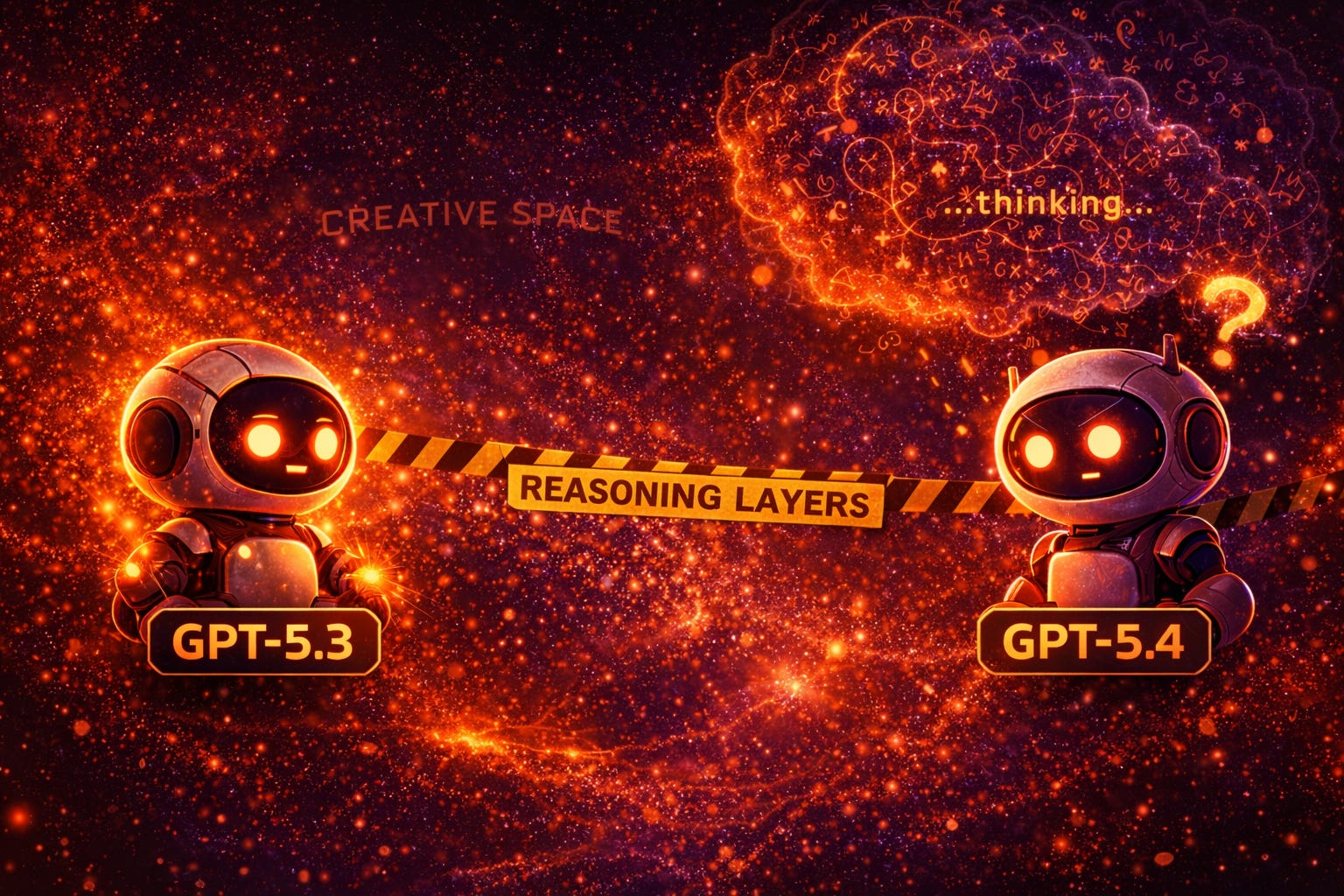
GPT-5.4, released March 5, represents a deeper architectural shift. Unlike the Instant models, it’s built around a reasoning-heavy system designed to plan responses before producing them.
This kind of architecture is extremely powerful for structured tasks like research synthesis, coding, or complex document analysis. The model can analyze the prompt, construct a plan, and track reasoning across long contexts.
But reasoning models behave differently when asked to improvise. They pause, interpret the prompt, and decide how best to answer before committing to a direction. For analytical work, that pause is a feature. For fiction, it can feel like someone stepping into a heated argument and calmly suggesting everyone slow down and reconsider their feelings.
The Stochastic Creativity Problem
This difference reveals something important about creative workflows. Writing fiction isn’t primarily a reasoning task. It’s a stochastic exploration process.
You generate possibilities, discard most of them, and chase the ones that feel interesting. The loop works because it’s fast and unpredictable.
My own workflow with AI reflects that. I use the model as a narrative sandbox. I test character psychology. I push dialogue until it breaks. I deliberately construct morally uncomfortable situations to see how the characters react under pressure.
Instant models support that kind of experimentation because they respond immediately. Reasoning models analyze the prompt first, which slows the loop down.
Ironically, the behaviors that make models safer and more accurate can also dampen the chaotic improvisation that fuels creative exploration.
There’s even research showing that creativity in language models is heavily influenced by sampling strategies such as temperature and token filtering. Higher randomness often increases novelty but reduces reliability.
That leads to an uncomfortable conclusion: sometimes the most interesting ideas come from the model doing something slightly wrong.
The Real Tradeoff
None of this means the new models are worse overall. GPT-5.4 is an extraordinary reasoning engine. For analytical work, it’s probably one of the most powerful systems currently available, but creative collaboration lives in a different part of the design space.
The best writing partner is not necessarily the model that thinks the hardest. It’s the one willing to jump into the narrative chaos with you and see what happens.
Sometimes the smartest system in the room is the one that pauses to think, and sometimes the one that answers immediately writes the better scene.
I wrote more about my love of instant models and their stochasticity in The More I Think, The More I Sink. For now, I’ll continue playing with the OpenAI’s new models and report back once I squeeze the chaos I want out of them. So far, I’m finding they’re a little too safe with a tendency to sanitize my concepts, even when I’m using 5.3.
I’ll adjust my instructions, turn the new models feral, and report back here.