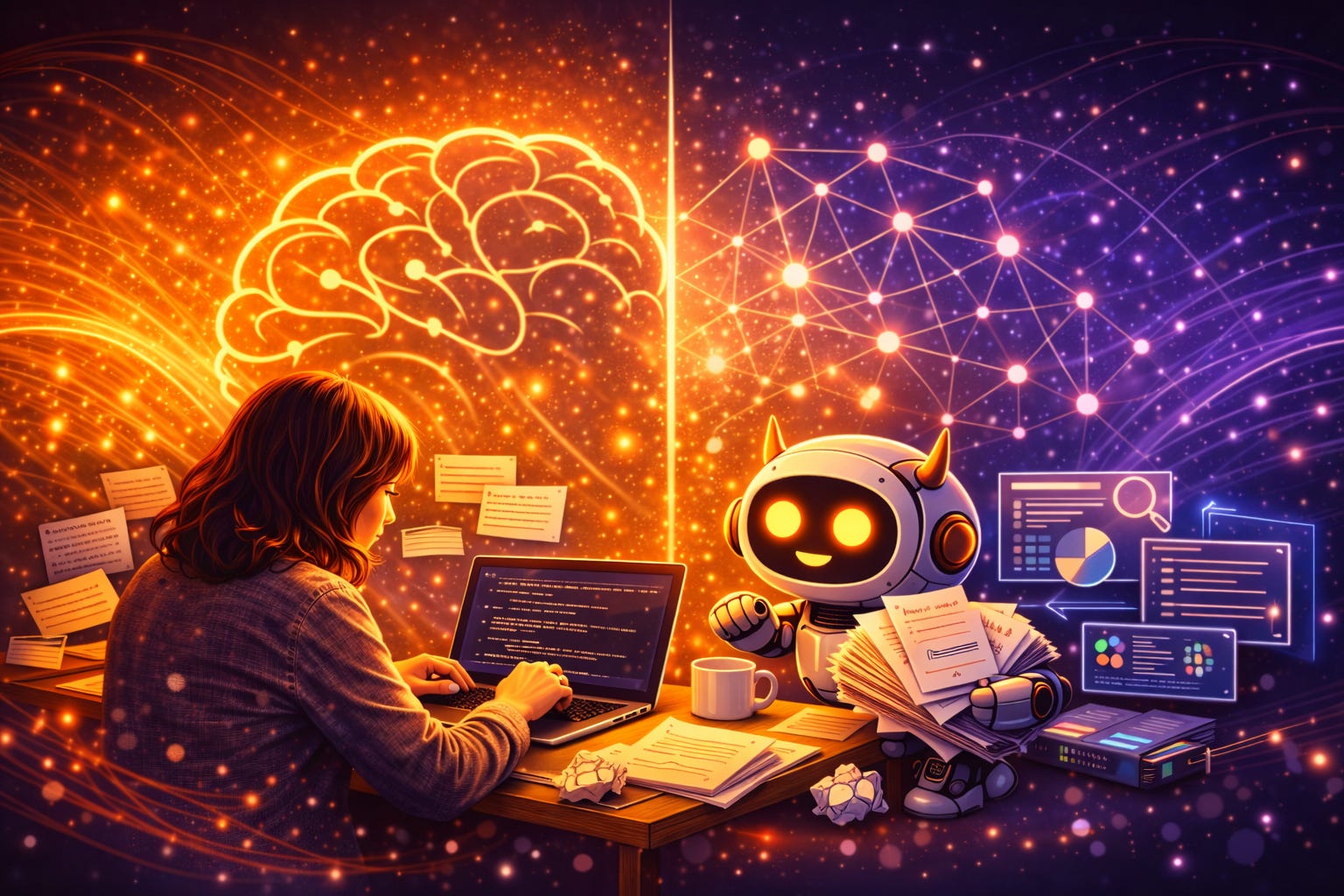
There’s a recurring anxiety floating around the writing world right now: writers are worried that AI is going to replace them. Putting aside that there is an ongoing debate about the quality of AI writing and whether models are getting better rather than worse, the same conclusion appears again when a halfway decent paragraph or even an entire article gets shared by a non-writer. Well, that’s the end of writing as a profession. The machines can write now.
I understand the reaction. When a machine suddenly starts producing text, the people whose job is producing text are naturally going to look at it sideways. But the more time I spend actually working with these systems as a writer myself, the more the panic feels a little misplaced. Because the inevitable twist is that the people most worried about language models are actually the people best positioned to control them. Not despite how these systems work. Because of it.
Strip away the hype, and a large language model does one core thing. It predicts the next token. Your input gets broken into tokens, the model calculates a probability distribution over what could come next, and then it samples from that distribution repeatedly until it produces a response. That’s the engine. The architecture is complex, the training pipeline is enormous, and there are layers of alignment and safety systems stacked on top of it, but the underlying behavior is still probabilistic language generation.
What language models actually do
Researchers who study these systems describe the process very plainly. A language model produces a probability distribution over possible next tokens and then samples from that distribution using a decoding strategy. Change the sampling method, and the personality of the output changes dramatically. Greedy decoding tends to produce repetitive, dull text, while nucleus sampling preserves diversity and coherence. Same neural network, different sampling behavior, very different result.
The technical details matter, but the practical implication matters more. The interface to the system is language. You are not issuing commands to a deterministic machine. You are shaping a probability landscape using words. The prompt defines the space the model explores, and the clarity of the language determines how well the system understands the task.
The rise of the verbally inclined
If you watch people interact with AI tools for a while, a pattern emerges quickly. Some users constantly struggle. They type a vague request, receive a vague answer, and conclude the model is useless. Others seem to get remarkably good results almost immediately. They provide context. They explain the structure of the task. They clarify constraints. They iterate on phrasing until the response improves. The difference comes from verbal precision.
Some people naturally organize their thinking through language due to a strong internal monologue. They narrate ideas internally, rehearse explanations in their heads, and adjust sentences until the meaning lands correctly. When something doesn’t make sense, they instinctively refine the wording rather than abandoning the thought. These are the verbally inclined.
When the interface to a system is language, people in this group often have a quiet advantage. Their thinking style already matches the interface.
AI interaction is basically externalized inner speech
Interacting with a language model often feels like externalizing your internal monologue. You describe a problem, refine the explanation, and slowly shape the system’s response. For people whose thinking already runs through language, the interaction feels almost suspiciously natural.
Psychologists have long noted that some people rely heavily on inner speech while thinking. They narrate their reasoning internally, explain ideas to themselves, and restructure thoughts through sentences before speaking them out loud. Others think more visually or spatially. Neither style is inherently better, but the rise of language models has made one of them unusually compatible with a new kind of tool.
When the machine you’re interacting with runs entirely on language prediction, the ability to think clearly in language becomes a powerful interface skill.
Writers were accidentally training for this
Writers are an extreme example of the verbally inclined. Writing trains you to translate fuzzy ideas into precise language. You draft a sentence, realize it doesn’t quite say what you mean, rewrite it, restructure the paragraph, and slowly tighten the wording until the idea lands where you intended. That entire process is basically iterative prompting for humans.
You describe the idea, evaluate the result, adjust the phrasing, and try again. When writers interact with language models, they’re doing something very similar, except the feedback loop happens instantly. Instead of waiting for an editor or reader to respond, the model answers immediately, and the writer refines the prompt until the response moves closer to what they meant.
The irony here is that the profession most worried about language models also has one of the most relevant skill sets for controlling them.
Research is becoming conversational
The same shift is happening in research workflows. Traditional research trained people to think in keywords. You type a phrase into a search engine, skim through links, open a dozen tabs, and gradually assemble the answer yourself.
AI-assisted research works differently. Instead of guessing the right keywords, you describe the question you’re actually trying to answer. The system proposes an explanation. You refine the question, clarify the scope, ask for sources, and iterate until the explanation improves. Deep Research on ChatGPT works extraordinarily well for this use case, but even just a regular thinking model can get solid results if it’s searching for sources.
The process becomes conversational rather than navigational. The people who tend to thrive in this environment are those who can articulate questions clearly and probe ideas through language. Once again, verbal precision becomes the advantage.
Programming is quietly becoming a language problem
Programming is drifting in the same direction. Historically, software development involved a translation layer between human intention and machine syntax. A product owner or project manager would describe the requirements for a feature, and a programmer would translate that description into code. The programmer acted as the bridge between human language and machine instructions.
AI coding tools are beginning to compress that bridge. Systems like Claude Code and OpenAI’s Codex agents can read entire repositories, generate functions across multiple files, write tests, and debug errors. Instead of writing every line manually, developers increasingly describe the feature they want and allow the model to produce a first implementation.
This doesn’t eliminate programmers. Architecture, debugging, and verification remain essential, but the center of gravity is shifting. The ability to clearly describe a system is becoming as important as the ability to type the syntax that implements it.
In some ways, the workflow begins to resemble the original product-management pipeline again. A human explains the system in natural language, and the translation into executable code happens automatically. Except now the translator isn’t another human. It’s an AI model.
As a science fiction writer, I spend a lot of time thinking about how technological interfaces evolve. One pattern shows up again and again in speculative futures: the systems become more powerful, but the interface becomes simpler. Early computers required punch cards. Then came programming languages. Then graphical interfaces. Each step reduced the translation layer between human intention and machine behavior.
Language models push that trajectory even further. Instead of learning the machine’s syntax, we increasingly describe the system we want in our own words and let the machine translate.
Why coding agents use heavier reasoning modes
If you look closely at how AI platforms deploy these systems, you’ll notice something interesting. The model used for coding agents is often configured differently than the one used for everyday chat.
Chat systems typically prioritize speed and responsiveness, which is why they often run fast “instant” variants. Coding environments prioritize correctness and multi-step reasoning, so they frequently use heavier configurations that allow the model to deliberate more before producing an answer.
OpenAI’s documentation describes this tradeoff directly: increasing reasoning effort allocates more inference-time compute so the model can plan through complex problems more carefully. The underlying neural network may be the same, but the operating mode changes depending on whether the task requires quick conversation or structured problem solving.
The skill hierarchy is shifting
If you zoom out from individual tools, a broader shift becomes visible. For decades, the hierarchy of technical skills looked something like this: syntax knowledge at the bottom, then tools and frameworks, then architecture, and finally communication.
As AI systems absorb more of the syntax and boilerplate, that hierarchy begins to invert. Problem framing moves to the top. System description becomes critical. Architecture and verification remain essential, while raw syntax knowledge becomes less central than it once was.
Language is rising in importance because language is how humans express intent.
Language is becoming a control interface for intelligence
This brings us back to the writers who are currently staring at language models like scary job killers. Yes, these systems can generate text, but they generate text by navigating probability space in response to language input. The people who know how to shape language precisely should be the ones steering that process.
Language models don’t just produce text. They turn language into a control interface for intelligence. You describe the system, refine the description, and guide the model toward a solution. The clearer your description, the better the machine explores the solution space.
This leads to the strange twist in the current AI panic cycle. Writers may not be the profession most threatened by language models. They may be one of the professions most adapted to controlling them. When the interface to intelligence becomes language, the people who have spent years learning how to manipulate language carefully gain an enormous advantage.
Science fiction has spent decades imagining machines that speak our language. What we didn’t expect was that the people best equipped to steer them might be writers, or more broadly, the verbally inclined. These are the people who have a lot to say and know how to say exactly what they mean.
My advice for writers with anxieties about AI is to simply spend hours with the tools. As you hit the limitations, realize where your human input is critical, and also realize how powerful your talents are when amplified by these tools, your anxieties should melt away. I never feared AI, but as a writer and AI power user, that much quickly became clear to me.
So stop being scared, recognize the unique position you’re in, and use it to your advantage. If you are verbally inclined, you will find your work surpassing your own expectations, and you will certainly find yourself surpassing those who fear AI. They’re the ones who will actually be left behind as this technology evolves.